
System Architecture
One mesh, from canopy to command.
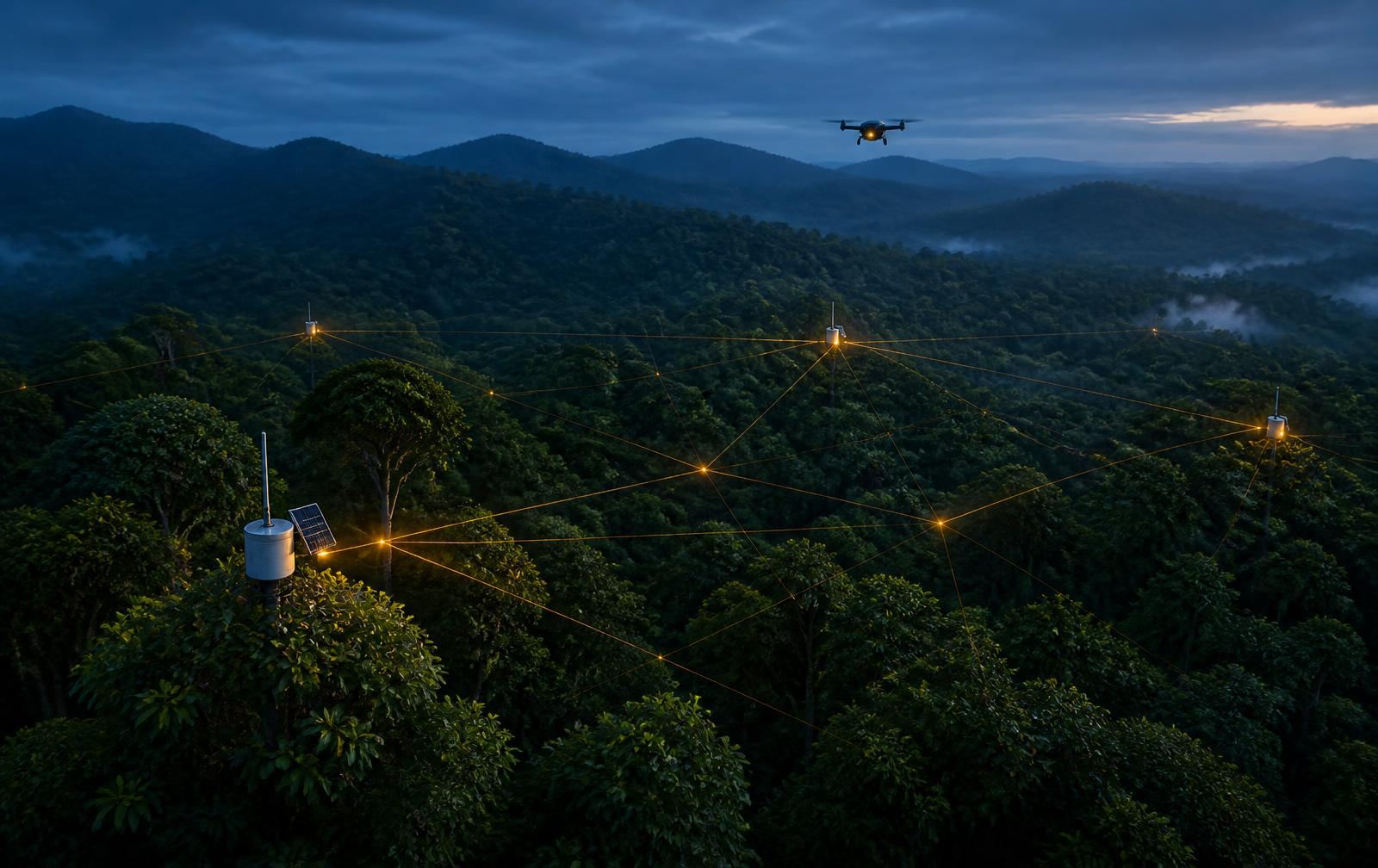
Every layer of Odraix is engineered for terrain where power is scarce and networks disappear. DeepSense multi-sensor nodes sense and decide on-device using Clip AI, our edge inference engine. Relays and gateways carry only classified events, drones keep the fleet current, and the India cloud turns forest signals into actionable intelligence for wildlife protection and forest surveillance.
Officer app
Alert + evidence
India Cloud
Analytics · retraining
Odra Gateway
4G / satellite uplink
OdraTrack
Patrol relay · SOS
Drone OTA
Firmware · harvest
DeepSense node
The layers
Six layers, one continuous signal path.
Forest Main Nodes
Acoustic · Gas · Night Vision
Solar-powered DeepSense units fuse three sensing modalities and run Clip AI inference on-device. They form the sensing edge of the Odraix IoT forest surveillance network, so only classified events leave the tree line.
Department Vehicles
Mobile LoRa relays
Patrol vehicles carry relay radios that extend mesh reach into valleys and shadow zones as they move through the beat, keeping DeepSense nodes connected even where fixed infrastructure cannot reach.
Central Gateway
Long-range aggregation
Odra Gateway aggregates node traffic, deduplicates events, buffers during outages and pushes encrypted data to the India cloud over 4G or satellite. It is the bridge between the forest mesh and command analytics.
Autonomous Drones
Firmware + data harvest
Scheduled flights deliver OTA firmware and model refreshes to DeepSense nodes and harvest bulk audio and imagery that no radio link should carry. This closes the loop between field deployment and continuous improvement.
Central Server
India cloud · analytics
Event storage, model retraining, map layers and long-horizon pattern analysis across the entire reserve. The India-hosted cloud ensures sovereign data control for forest departments and conservation agencies.
Forest Officers
Mobile app + dashboard
Classified alerts with location, confidence and evidence land with the officer nearest the incident, while OdraTrack safety telemetry keeps patrol teams visible and reachable in the most isolated territories.
Signal path
From a sound in the dark to a phone in a hand.
DeepSense edge AI nodes continuously listen, watch and sample the air. When Clip AI classifies a threat, the verdict — not the raw media — travels through the LoRa mesh, Odra Gateway and India cloud to the nearest forest officer.
Detect
Node senses event
Classify
Clip AI on-device
Relay
Mesh / vehicle hop
Gateway
Aggregate + buffer
Cloud
Store + analyse
Officer
Alert delivered
Edge intelligence
Clip AI is the brain inside every DeepSense node.
Clip AI is Odraix's proprietary edge inference engine. It fuses acoustic, gas and night-vision inputs directly on the DeepSense node, classifying threats in milliseconds without sending raw audio or imagery over the air. That means lower bandwidth, longer battery life and instant alerts even when the forest has no connectivity.
Built for the realities of Indian forests — poor networks, harsh weather and limited power — Clip AI turns each node into an autonomous decision maker. It is the core reason Odraix IoT forest surveillance works where cloud-only solutions fail.
Clip AI inference core
DeepSense edge AI · local classification
Why on-device matters
Sending uncompressed audio and video from hundreds of nodes would overwhelm any forest network. Clip AI compresses the world into decisions: gunshot, chainsaw, fire, vehicle or wildlife — each delivered as a tiny, timestamped event payload.
Offline is the default
Every layer assumes the next one is unreachable. DeepSense nodes queue, Odra Gateway buffers, and Clip AI keeps deciding locally — nothing is lost when the forest link drops for days.
Decide at the edge
Clip AI classification happens where the signal is born, so the LoRa mesh carries verdicts instead of raw audio or video streams. That is how Odraix edge AI scales across large reserves.
Adaptive routing
The self-healing mesh re-forms around dead nodes and moving vehicle relays without manual reconfiguration, keeping the IoT forest surveillance network alive in unpredictable terrain.
Sovereign storage
Event data, Clip AI models and analytics live in India-hosted infrastructure with encrypted transport end to end, giving forest departments full control over sensitive ecological information.
Map this architecture to your landscape.
Talk to Odraix Labs about DeepSense node density, Clip AI model deployment, Odra Gateway placement and autonomous drone maintenance cycles for your forest reserve or protected area.